
We’ve all had it happen.
We walk into a retail store or a used car lot and for the next two-three hours you are arm wrestling over figures and features and add-ins, haggling the whole way while spitting fire at each other through your glistening smiles. It is the bane of every American consumer: The Salesman.
But, it isn’t always like that. Or at least, it doesn’t always have to be like that.
In many cases, your salesman can be your greatest ally in the suit store. They know the ins-and-outs of their profession and they know what will fit your needs the best. The hardest part for them is identifying your needs so they can cater to you. So, the best thing you can do to prepare to buy a suit is to have a good idea of what your particular needs are. If you walk in the store and say you’re “just looking,” or “I don’t know exactly what I want,” the inexperienced salesman, the one who has not yet figured out how to identify needs, will take you to the most expensive suit in the store. The more experienced salesmen will glean information from his interaction with you, and will fit you in the best suit in the store.
Now, when I say “the best suit,” please understand that what I mean is that the best suit in the store is the suit which suits your needs the best. That is the distinction between the best suit and the most expensive suit.
So, there are a few things you can do to help your salesman give you the best deal on the best suit in the store.
Know the balance between expertise and preference:
My first job in High School was working at Chick-fil-a. I don’t think I know anyone who is prepared to argue the fact that Chick-fil-a is probably the worlds leading business in customer service. During the three years I spent taking and filling orders, cooking and prepping chicken, I must have heard the phrase “the customer is always right” close to a thousand times. When I went to other jobs, I again heard the phrase thrown around as if I was always wrong. Imagine my shock when I learned the quote in its entirety for the first time. “The customer is always right, in matters of taste.”

Now, this never impacted the way I treated customers. Rather, what it did for me was enabled me to back up my professional expertise with confidence and authority. This quote is not saying that the salesman is right in all other instances, but rather it emphasizes the role of the customer’s preference as the trump card over the salesman’s expertise. Now, what does this mean when it comes to the suit sale? Well, any well trained salesman who knows this principle will always guide you towards the right fit and cut and color and style, but in the end the client sets the boundaries for their realm of taste. So when you enter a suit store, be prepared to have an opinion. And if you don’t have an opinion, try really hard to have a preference. After that, trust in the guidance of your consultant. After all, he is only there to help you look your best.
Know your needs and preferences:
Throughout my time as a menswear consultant and salesman, I was frequently assigned new hires to oversee their training and mentor them in their first few weeks at the store. One of the first things I told every single one of them is that our job as salesmen and saleswomen is to identify the needs of our clients and present them with a product that fills those needs. I presented to them what eventually developed into the SOB method: Size, Occasion, and Budget. All of any clients needs will fall into one of these three categories. To have the best experience when expanding your wardrobe, you should also consider having the questions relating to the SOB method handy, so that you can find the perfect suit.
Size- Whether the client knows it or not, size is the first need they should consider. Most customer’s I have helped have walked in the store with an attitude of “you’re the expert, you tell me what looks good.” in matters of getting the right size, they are probably correct to lean on the professional opinion. When it comes to the cut of the suit, that is another matter entirely.
We the professionals can tell you what the standard is, what will compliment your body type the best; whether that be portly, slim, athletic, modern, or skinny. However, many times clients will ask for a suit that gives them extra room in the girth, losing the slimming features of a modern or athletic cut. Likewise, a lot of the younger generation prefer the ultra-slim look, and so they will sometimes size themselves in a suit one or two sizes/cuts smaller than the one the consultant fits them in. This doesn’t mean either is wrong, just that the salesman and customer have differing opinions on their preferred style.
Whatever the clients taste is in cut should be catered to, but you should still expect a few words of council from your consultant or salesman.
Occasion- The occasion is the second factor every salesman must consider when fitting a man for a suit. The man coming in for a suit to wear to a job interview should be shown different suits than to the one who is coming in for a cocktail party. Same as a wedding versus a funeral or a Quinceñera versus a night at the Casino. Every occasion requires a different suit.

Now what does that mean? How does occasion effect the suit? Well there are three main considerations here: color, style, and pattern. While black suits are commonly used for weddings, there is also a wide variety of other colored suits which are used in weddings, each as popular in their own season as black is. Light grays and dusty/powdered blues have almost a complete monopoly over every wedding between March and August. Charcoals and navies are popular through the winter. Earth tones such as tans, browns, and forest greens (yes, I did say green) are all the rage throughout the fall months. While you could get away with a few of those colors at a funeral (black, charcoal, navy), the majority aren’t viable options for that particular occasion. Similarly, a black suit would be out of place at a cocktail party or a boho wedding.
The second element of occasion you must consider is the style of the suit. Now, there is some elements of style that comes in with the cut of the suit as discussed above that play a role in style, but there are so many other parts of a suit that can add or detract from your ability to dress up to certain occasions. Some stylistic decisions may work great for some occasions, and not for others. Lets run through a few of those.
Contrasting buttons and button holes will pull every eye to you. This makes it a great choice for a businessman accustomed to giving presentations, but it could prove distracting from a wedding or funeral. As long as a pic stitch is tonal with the color of the suits main body, it should be able to pass for formal or informal occasions. If it is contrasting or accentual, then it can be treated the same as the contrasting buttons. Wide lapels are coming back, but only through the informal events as of right now, as is the double-breasted suit. Slanted pockets are quickly becoming a staple in the trending suits of the day, so stay away from those for your black tie events. Anywhere else you will be the life of the party. For more information about the specific stylistic choices as part of the suit, check out my article on the anatomy of a suit; Suits 101: Anatomy of Style.
The final element of occasion is the pattern, which arguably, could be included within the style, but I felt it was different enough to distinguish between the two. When I say pattern I am referring to the pattern on the main body of the suit, what does the actual suit look like? The best rule of thumb I can give you is that the more formal an occasion is, the less pattern and variation you should have across your entire ensemble. Window-panes are back in full force, but I would avoid them in stark contrasting colors or bold patterns for anything remotely formal. Pinstripes have lost their popularity, but I have seen a few recently that I have really liked. So long as they are not to bold, they would work well in most business settings. The pattern I am seeing most frequently these days is not much of a pattern at all, more of a texture. It’s called the thatch, where the threads make an interweaving thatched appearance of the suit. This gives the suit depth and range of color options that most other patterns do not. This can be used almost universally across the spectrum, except the most formal of settings, such as black tie weddings or funerals. The last, of course, is the solid. When not accompanied by accented buttons and contrasting button-holes, the solid is your go to for anything formal. But it would be out of place at a day at the races. This brings us to our third and final aspect of the SOB method…
Budget- Every customer, no matter what you tell your salesman, has a budget for their suit. There is a limit to how much a proper suit and fitting is worth to you. Find out what that range is, and prepare to compromise. Many grooms are operating on a tight budget for their wedding suits, what with their life savings being spent on the cake, venue, entertainers, and the brides dress which costs three times as many times as the suit and yet will be worn only the smallest fraction as many times as the groom will wear his suit. Likewise, funeral guests typically don’t have any funds dedicated towards buying a new suit for their uncle’s funeral who just two months ago was the spitting image of health and virility. Bottom line is, whether the circumstances are in their control or not, everyone has a budget. Therefore it is one need you must consider for yourself.

Along with budget you must also consider the quality of material. The biggest example of this is for when people want to rent a suit. Why rent a suit that you will only wear once when you can purchase a suit that is not only much higher quality, but also fits you better and will last longer for only twice as much as what you’d pay for a rental? This same argument can be made to a polyester suit vs. a poly-wool, or a poly-wool vs. a full wool, or a super-100’s wool v. a super-180’s wool. Yes, you may be paying a little more up front, but as long as it is the right suit for you, it will be cheaper in the long run.
Finally, be ready to compromise. List out what your needs are for each of these categories and then rank them in order of what is most important to you. Is price the most important thing? Or is it cut and size? Or is it a style or color? There are ways to ensure you get the best suit for you, but sometimes, that will come at the cost of compromising on a few of your lesser needs.
Respect the salesman’s ethics:
Now, I promise this is not me saying this just to make my life easier. In fact, its quite the opposite.
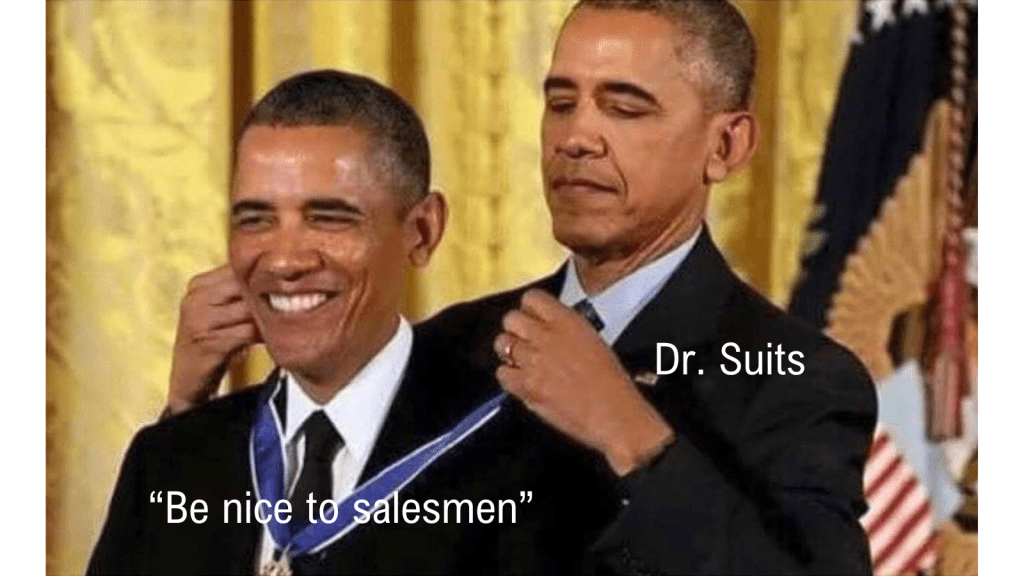
By the golden rule of “treat others how you would like to be treated,” salesmen are much more likely to go the extra mile with the client they feel like they are friends with, than the one who is moping and complaining about everything they do. Here are a few things you can do to help with that.
I have worked with many salesmen before, and I have had great examples of salesmen who treat every customer with insurmountable respect. I have also worked with salesmen who try to squeeze every spare penny out of their customers. But for the most part, salesmen, saleswomen, and consultants run somewhere in between, where we do the best we can to help out our customers to the best of our abilities, and sometimes we make mistakes that make the customer’s life difficult. I’ve been at fault for this before, especially in my early years as a salesman. However, if there is one thing you should never do as a consumer, it is tick off your salesman. Because believe it or not, they know exactly which “mistakes” to make that will cause you greater grief, but which will not get him/her fired. (Clarification: rarely is it that a salesman goes out of his/her way to make a clients life miserable. More likely, they will just try less hard to get you what you need if you insult them.)
I have worked with flustered and angry clients before. These are not they who I speak about. That is a natural part of the human existence, and some of those clients were my greatest experiences as a salesman when I was able to do a little to brighten their day. What I am referring to is low-balled comments that call out the salesman’s/saleswoman’s ethics, comments which infer that they are suggesting a specific product just for the commission. Or, even worse, when they haggle over price. The salesman/consultant knows the restrictions and loopholes in his store’s policy; he will either use them to go the extra mile for your or inflict vindictive karma. In the end, if you try to haggle or belittle, the salesman always wins.
Conclusion:
When it comes down to it, if you are to make your personalized style a part of your lifestyle, then your relationship with your salesman can be your greatest asset when it comes to your wardrobe. Treat him with respect, and he will prioritize the fulfillment of your needs.
Disclosure: As an affiliate, the author of this article may receive compensation for any promoted products purchased. I have personally tested the majority of the items, and do not promote any brands or products of which I have not had a reliable amount of experience with and whom I do not stand behind.

 Dr. Suits Menswear Mentoring
Leave a comment